
Article: The evolution of the cave's entrance of Bruniquel and consequences for its accessibility by early Homo neanderthalensis
Abstract
The cave of Bruniquel, discovered by cavers in 1990, contains the oldest evidence of deep cave use by early Homo neanderthalensis. The discovery and dating of speleothem-based structures and fireplaces demonstrated their ability to investigate the deep subterranean environment in a structured way (Jaubert et al., 2016). The cave has been closed by a succession of rockfalls, flowstone layers and scree cone deposits, which led to the preservation of multiple traces of human and animal activity inside the cave. We studied the cave entrance evolution through a multidisciplinary integrated geomorphological approach, combining 3D surveys inside and outside the cave system, high-resolution geomorphological mapping, Electrical Resistivity Tomography (ERT), and U-series dating. The combination of stratigraphic surveys and U-series dating allowed us to date the closure of the cave to before 142.9 ± 1.3 ka, before the Last Interglacial, thus independently confirming the age of the speleothem structures and of the other traces observed on the cave floor. The proposed virtual 3D reconstruction of the palaeo-cave entrance at the beginning of MIS 6, suggests an entrance less than 2 m high, implying that the space behind the entrance was rapidly dark. This work highlights the central importance of understanding the evolution of cave entrances for constraining the timing and the modalities of use of cave systems and provides a new palaeogeographic framework for future studies of the cave's occupation by early Homo neanderthalensis.
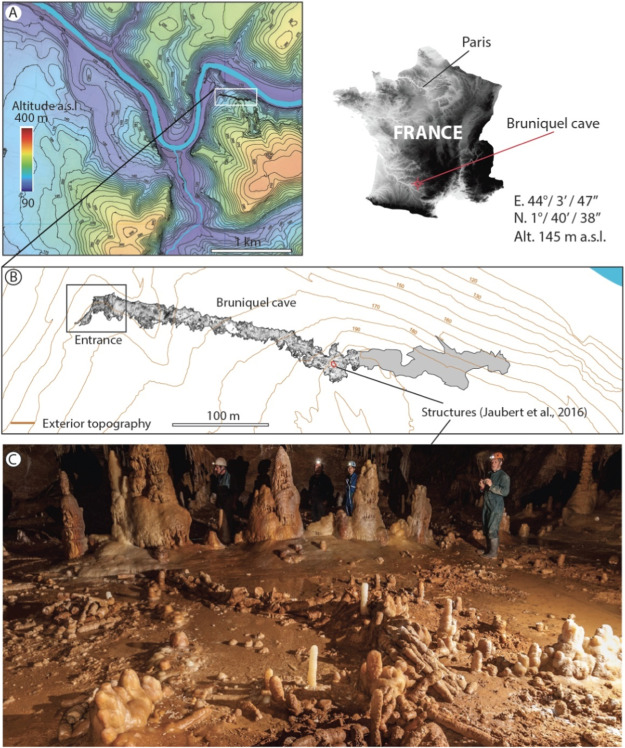
Location map of the cave of Bruniquel. A. Location of the cave compared to the fluvial system of the Aveyron canyon; B. Closeup to the cave. The first part of the cave (shaded gray) is based on the elevation model of the soils, issues from the 3D laserscan point cloud performed in 2022. The topography of the limits of the last part of the cave (gray area) is based on the acquisitions by Camus et al. (2015); and Camus and Muth (2016); C. The anthropic neanderthal-made structures inside the cave. Those constructions are made of broken speleothems (« speleofacts », i.e. Jaubert et al., 2016; photograph from: L-H. Fage). Cave topography is based on the laserscan acquisitions of AGP + EDYTEM + this work. Genuite et al., 2026