
Rolling through time: Scarab remains reveal 4,000 years of coastal pastoralism and biodiversity dynamics in western France
Abstract
Erosion along the French Atlantic coastline is revealing unrecorded archaeological sites, while the shoreline retreat threatens this fragile heritage with irreversible loss. In waterlogged, anoxic sediments, insect remains are preserved in exceptional condition, enabling reconstruction of past human activities through archaeoentomological analysis. A diverse assemblage of dung beetles provides robust evidence of livestock farming from the Neolithic to Antiquity, revealing spatial and temporal variation in grazing intensity. High proportions of dung-associated species in a Middle Neolithic well indicate substantial herds as early as 5500 years ago. This provides the first evidence of coastal livestock farming in Neolithic France, illuminating a tipping point in the history of humankind. In other contexts, lower proportions imply limited grazing, potentially constrained by saline water sources. The diversity and dominance of aquatic and riparian taxa reflect a water-rich environment used for animal watering, while abundant pasture-associated taxa indicate an open landscape favorable to agropastoral practices. Comparisons between fossil and modern entomofaunas from the Gironde region reveal biodiversity shifts shaped by climatic change and human influence over millennia. These multi-millennial bioarchaeological archives offer unique insights into the deep history of biodiversity dynamics and inform debates on ecological change and evolution.
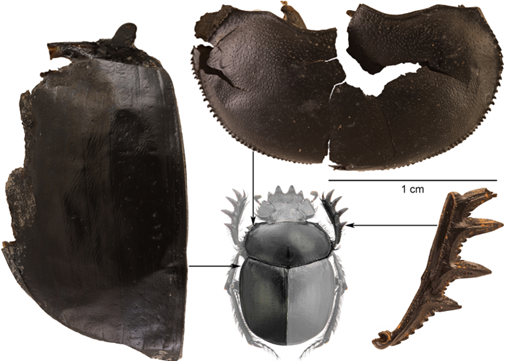
Modern specimen of Scarabaeus typhon (Fischer, 1823) [Scarabaeidae], with fossil remains from ST8 (photo L. Richelmi).
Researcher contact
Lisa Richelmi, PhD Student, PACEA (GPR "Human Past")
Reference
Lisa Richelmi, Jean-Bernard Huchet, Frédéric Santos, Florence Verdin,
Rolling through time: Scarab remains reveal 4,000 years of coastal pastoralism and biodiversity dynamics in western France,
Journal of Archaeological Science, Volume 185, 2026, 106442, ISSN 0305-4403