
Climatic variability, vegetation dynamics, and cultural innovation in Southern Africa during the Middle Stone Age
Abstract
Paleoenvironmental reconstructions in southern Africa have often relied on isolated or fragmentary records, limiting our understanding of ecosystem dynamics during the Middle Stone Age (c. 300–40 ka). Here, we reassess vegetation and climate change between Marine Isotope Stages (MIS) 5 and 3 using high-resolution pollen records from two deep-sea cores—MD96-2048 (eastern margin) and MD96-2098 (western margin)— and contextualize these data with other marine (MD20-3592; 3CD154-17-17K) and terrestrial records. The pollen sequences reveal coherent, regionally synchronous trends:
glacial periods were cooler and wetter, reflected in the expansion of Fynbos and Afromontane Forest, while interglacials were drier, marked by forest retreat and Nama-Karoo spread. In contrast to terrestrial records, which often reflect localized and inconsistent patterns due to taphonomic and ecological factors, these offshore archives provide a robust sub-continental signal. Comparisons with archaeological data suggest that the Still Bay (SB) technocomplex emerged near the MIS 5a/4 transition, during a humid phase of elevated environmental productivity. The Howiesons Poort (HP) technocomplex appeared slightly later (~68–64 ka), under conditions of climatic instability and ecological fragmentation. These contrasting ecological backdrops imply that cultural change was not driven by climate alone, but by complex interactions between environmental variability, technological innovation, and population connectivity.
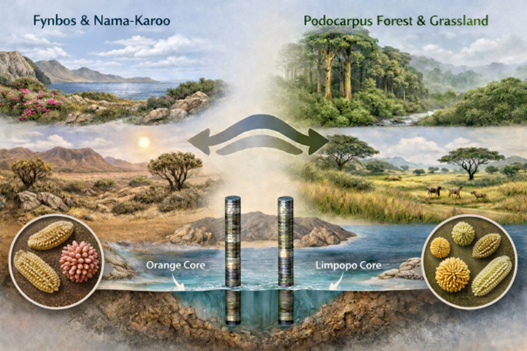
This illustration summarises the main environmental models reconstructed in the study between Marine Isotope Stages (MIS) 6 and 3, between 180,000 and 30,000 years ago, based on marine pollen records. © Francesco d'Errico, CNRS
Researcher contact
Francesco d'Errico, Directeur de recherche CNRS, PACEA
Reference
García-Morato, S., Sánchez-Goñi, M. F., Urrego, D., d’Errico, F. (2025). Climatic variability, vegetation dynamics, and cultural innovation in Southern Africa during the Middle Stone Age. Communications Earth & Environment