
From Preservation to Transformation: Taphonomic Analysis of Archaeological Insect Remains from the French Atlantic Coastline
Abstract
Insect remains can provide unique insights into past environments, yet their preservation and post-depositional alterations – particularly chromatic changes – remain poorly understood. Recent excavations along the French Atlantic coastline uncovered numerous archaeological structures dating from the Neolithic to Late Antiquity. Archaeoentomological samples collected from these structures reveal significant variations in the preserved insect remains.
The frequency of morphological alterations, degree of fragmentation, and quantity of subfossil insects recovered vary between samples, influenced by the type of archaeological structure, the embedding substrate, the storage methods, and the taxa considered. Chromatic alterations, visible to the naked eye, appeared more uniform. This pilot study initially aimed to determine whether fibre-optic reflectance spectroscopy could detect original colouration no longer visible to the naked eye, by comparing archaeological specimens with modern reference material. Spectral analyses showed colour differences
correspond to taphonomic alterations rather than hidden original hues. By documenting these changes and assessing spectroscopy’s applicability to archaeoentomological material, this study establishes a methodological baseline and reference dataset, opening new avenues for insect taphonomy research and improving palaeoenvironmental reconstructions.
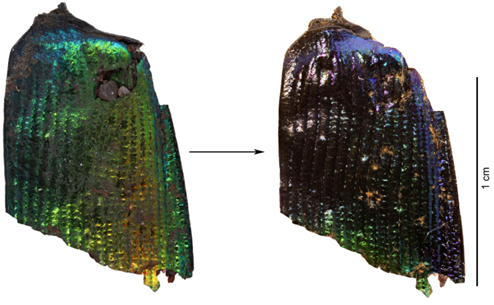
Chromatic alteration after drying of an elytron of Calosoma sycophanta collected from ST35 (photo L. Richelmi and J. Rollin, 2022).
Researcher contact
Lisa Richelmi, PhD Student, PACEA (GPR "Human Past")
Reference
Lisa Richelmi, Jean-Bernard Huchet, Aurélie Mounier & Florence Verdin (19 Oct 2025): From Preservation to Transformation: Taphonomic Analysis of Archaeological Insect Remains from the French Atlantic Coastline, Environmental Archaeology