
Fieldtrip to La Roche à Pierrot Saint-Césaire
Samedi 4 juillet 2026
Le gisement de la Roche-à-Pierrot, à Saint-Césaire (Charente-Maritime), a livré une séquence exceptionnelle de près de 30 000 ans d’occupation humaines documentant la période de transition entre les derniers Néandertaliens et les premiers Homo sapiens en Europe. Une succession de niveaux archéologiques rapportés au Paléolithique moyen (Moustérien) et au Paléolithique récent (Châtelperronien et Aurignacien) y ont été fouillés dès 1976 par François Lévêque (Ministère de la Culture ; Levêque et al., 1993). Avec la découverte en 1979 d’un squelette relativement complet d’un Néandertalien dans un niveau attribué alors au Châtelperronien, le site de La Roche-à-Pierrot représente depuis une séquence archéologique majeure d’Eurasie occidentale alimentant les débats sur les processus de remplacement des derniers Néandertaliens par les premières populations d’Homo sapiens arrivant en Europe il y a entre 50 à 40 000 ans.
La sortie de terrain à Saint-Césaire, point d’orgue de l’école d’été, offrira aux participants une occasion rare de s’immerger directement dans un site de recherche en activité et d’explorer comment l’archéologie numérique renouvelle notre compréhension de la préhistoire humaine.
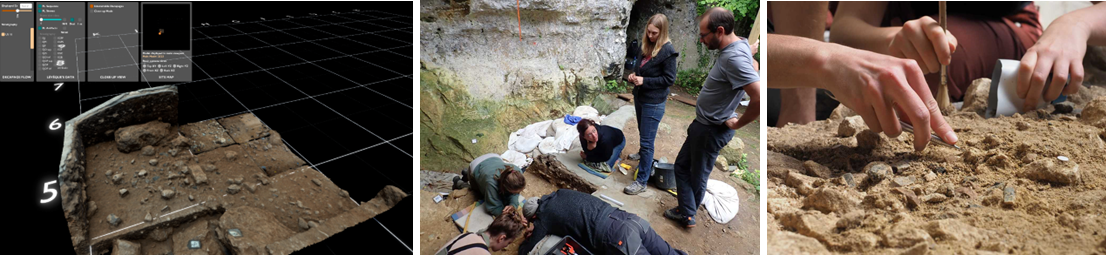
©I. Crevecoeur, Archéosphère
Saturday July 4, 2026
The Roche-à-Pierrot site in Saint-Césaire (Charente-Maritime) has yielded an exceptional sequence of nearly 30,000 years of human occupation, documenting the transition period between the last Neanderthals and the first Homo sapiens in Europe. A succession of archaeological levels dating back to the Middle Paleolithic (Mousterian) and Late Paleolithic (Châtelperronian and Aurignacian) were excavated here in 1976 by François Lévêque (French Ministry of Culture; Levêque et al., 1993). With the discovery in 1979 of a relatively complete Neanderthal skeleton in a level then attributed to the Châtelperronian, the La Roche-à-Pierrot site has since represented a major archaeological sequence in western Eurasia, fuelling debate on the processes by which the last Neanderthals were replaced by the first Homo sapiens populations arriving in Europe between 50 and 40,000 years ago.
Ongoing international and multidisciplinary research is now re-examining the site using cutting-edge digital and geoarchaeological methods.
The field excursion to Saint-Césaire, the highlight of the Summer School, will offer participants a rare opportunity to engage directly with an active research site and explore how digital archaeology reshapes our understanding of human prehistory.