
Path description
3D Archeology at a macroscopic scale (site, object)
The approach “digital archaeology at the macro scale” aims to provide tools, methods, and a vision of fieldwork in archaeological site that encompasses the artefact, and its spatial organization.
Multliple tools such as lasergrammetry and photogrammetry and how to process the data will be discussed through this approach, and will be applied to different archaeological questions, from the artefact to the landscape.
The macro scale approach will focus on how to represent archaeological data in 3D, how to model their direct environment, how to process them
by spatial analysis (geographical and topographical tools), and how to disseminate to the public at large.
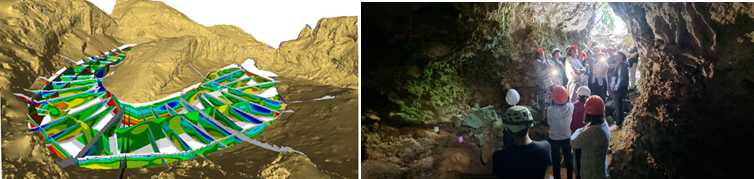
©K. Genuite & M. Abdou
Geometric Morphometrics
In recent decades, we have observed a growing interest among archeological communities in geometric morphometric analyses. This approach consists in quantifying shape variation of complex biological or material aspects. It is based on the use of geometrically homologous landmarks and semi-landmarks. It allows the quantification and visualization of changes in these objects, both in terms of size (dimensions) and conformation (arrangement of the object components), either separately or jointly. Finally, geometric morphometric studies investigate intra- and inter-individuals shape variation and covariation with other variables such as environmental, genetic or behavioral ones.
Throughout this Summer School in Digital Archeology, we will present these tools and methods used in geometric morphometrics: from data segmentation to landmark setting and statistical analyses, both on 2D and 3D data. We will also discuss some dilemmas addressed in the current literature.
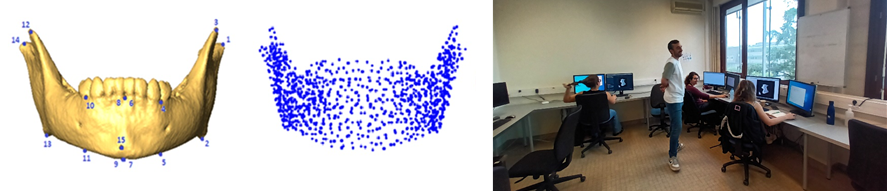
©F. Rémy & A. Le Cabec
3D Archeology at a microscopic scale (surfaces)
In the last two decades, substantial efforts have been invested to develop quantitative methods to study surfaces at microscopic scale. These methods allow the quantification of surface modifications and visualization of textural variations independently of the shape of the studied area. The fields of application of this approach are very broad, including taphonomy, technology, and palaeontology, especially the feeding behaviours of extinct animal species.
Throughout the Summer School in Digital Archaeology, we will introduce and allow participants to gain first-hand experience with the tools and methods used in quantitative microscopic surface texture analysis. Participants will acquire data with confocal microscopy, process it, and compare their results with reference collections.
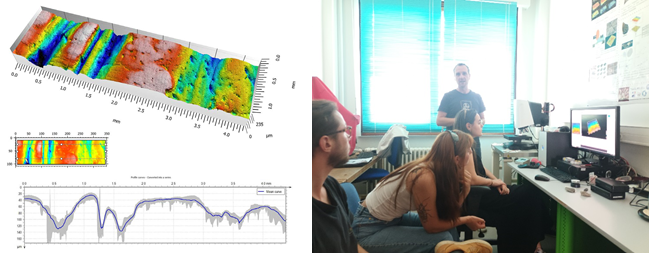
©Li et al., 2019 & A. Le Cabec