
When the ocean saved Neanderthals: The hidden climate story of southwestern France
A recent study in Proceedings of the National Academy of Sciences (PNAS) has uncovered a major shift in Neanderthal history (1). By analyzing ancient DNA from across Europe, Fotiadou and colleagues show that most Late Neanderthals descend from a single population that emerged around 65,000 years ago in southwestern France, before spreading across the continent.
This finding points to a population contraction followed by a large-scale re-expansion from a refugium, a region where populations persisted during harsh climatic conditions. Yet a key question remained: why was this refugium located in southwestern France, rather than in the southern European peninsulas that typically played this role during glacial periods?
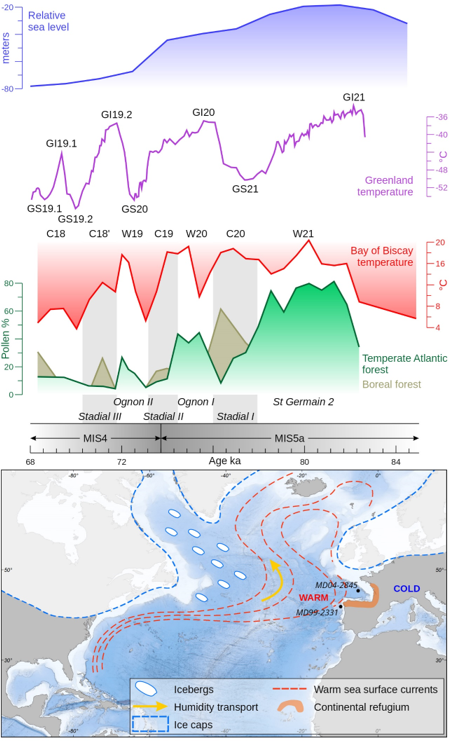
In a new Letter to the PNAS Editor (2), María Fernanda Sánchez Goñi and Francesco d’Errico, researchers a the university of Bordeaux, propose that the answer lies in a specific climatic configuration that developed at the onset of the last glaciation, between about 76,000 and 68,000 years ago. During this period, the southward displacement of the polar front pushed the Gulf Stream further south, causing warm Atlantic surface waters to become concentrated along the western European margin and effectively trapped in the Bay of Biscay. At the same time, continental Europe experienced significant cooling. This combination created a strong thermal contrast between a relatively warm ocean and a cooling landmass. The resulting ocean–atmosphere gradient enhanced evaporation from the Atlantic and increased moisture transport toward southwestern Europe, maintaining milder and more humid conditions along the Atlantic façade while much of inland Europe became colder and more arid.
Under these conditions, southwestern France formed a stable and productive ecological zone, with mosaic landscapes capable of sustaining higher population densities than surrounding regions. This mid-latitude refuge provides a direct environmental explanation for the genetic pattern identified by Fotiadou et al.: a contraction of Neanderthal populations into this area followed by their re-expansion across Europe once conditions improved.
By linking paleoclimatic processes with archaeogenetic evidence, the study shows that refugia are not simply determined by latitude but emerge from regional interactions between ocean circulation and atmospheric dynamics. This work highlights how localized climate mechanisms can shape the demographic history of human populations and offers a more complete understanding of the processes that structured the final phases of Neanderthal evolution.
1. C. M. Fotiadou et al., Archaeogenetic insights into the demographic history of Late Neanderthals. Proc. Natl. Acad. Sci. U.S.A. 123, e2520565123 (2026).
2. M.F. Sanchez Goni and F. d’Errico, Climatic mechanisms underlying a southwestern French Neanderthal refugium at the onset of the last glaciation. Proc. Natl. Acad. Sci. U.S.A. (2026), https://doi.org/10.1073/pnas.2610884123
Reference
M.F. Sanchez Goni and F. d’Errico, Climatic mechanisms underlying a southwestern French Neanderthal refugium at the onset of the last glaciation. Proc. Natl. Acad. Sci. U.S.A. (2026), https://doi.org/10.1073/pnas.2610884123