
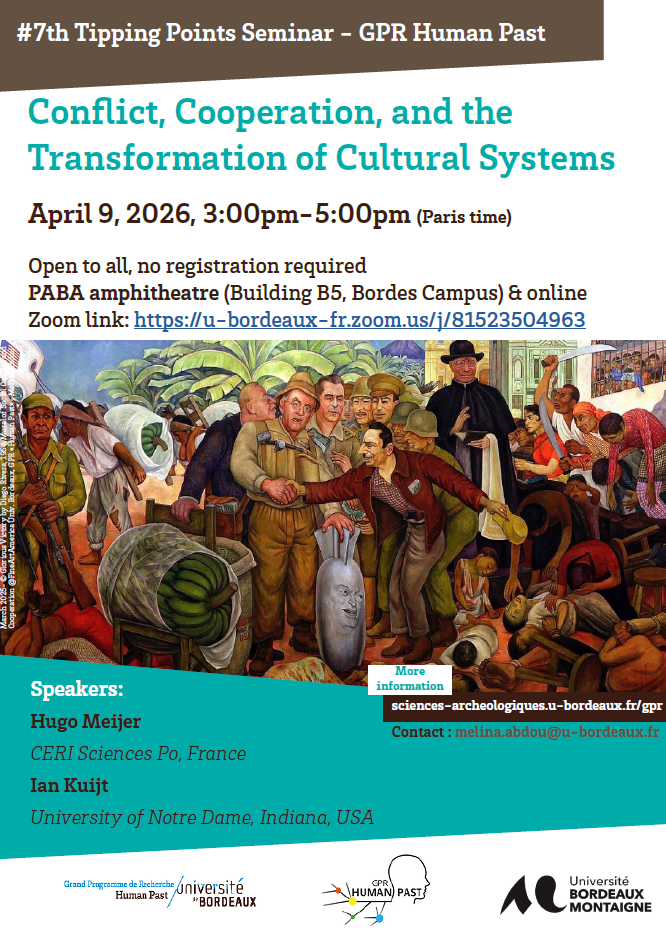
Conflict, Cooperation, and the Transformation of Cultural Systems
For the seventh Tipping Points Seminar, the GPR "Human Past" invited:
- Hugo Meijer - CNRS Research Fellow at the Center for International Studies (CERI) at Sciences Po, France
- Ian Kuijt - Professor of Anthropology at the University of Notre Dame, Indiana, USA
The seminar was held on April 9, 2026 from 3pm to 5pm (Paris time).
The speakers were present online, and the audience was able to follow the seminar from the PABA amphitheatre in building B5 (Bordes Campus, University of Bordeaux).
We warmly invited participants to gather at the PABA to encourage discussion between the audience and the speakers following the presentations.
Abstract of the seminar
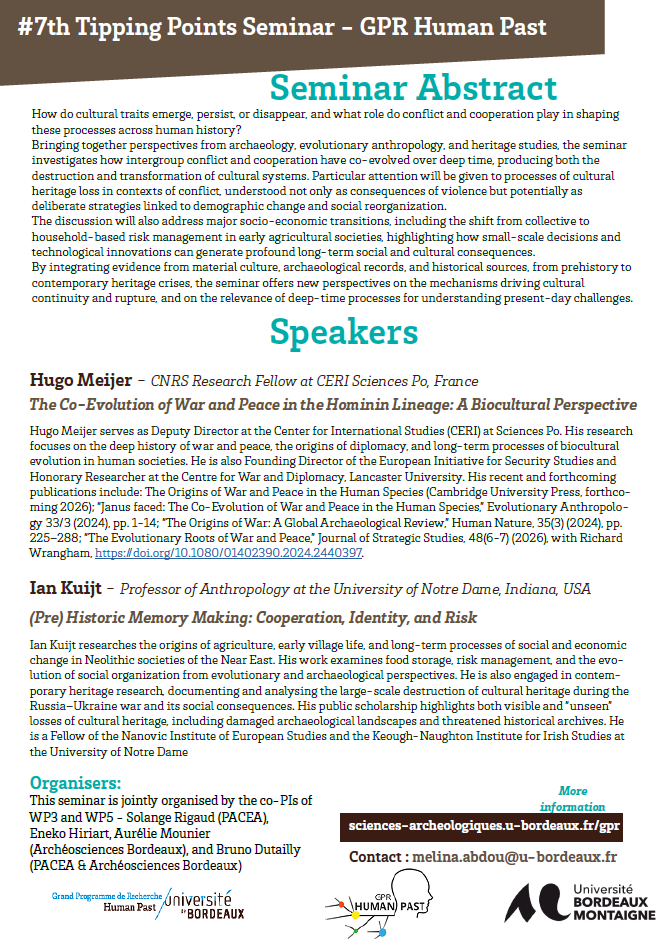
How do cultural traits emerge, persist, or disappear, and what role do conflict and cooperation play in shaping these processes across human history? Bringing together perspectives from archaeology, evolutionary anthropology, and heritage studies, the seminar investigates how intergroup conflict and cooperation have co-evolved over deep time, producing both the destruction and transformation of cultural systems. Particular attention will be given to processes of cultural heritage loss in contexts of conflict, understood not only as consequences of violence but potentially as deliberate strategies linked to demographic change and social reorganization. The discussion will also address major socio-economic transitions, including the shift from collective to household-based risk management in early agricultural societies, highlighting how small-scale decisions and technological innovations can generate profound long-term social and cultural consequences. By integrating evidence from material culture, archaeological records, and historical sources, from prehistory to contemporary heritage crises, the seminar offers new perspectives on the mechanisms driving cultural continuity and rupture, and on the relevance of deep-time processes for understanding present-day challenges.
Speakers
- Hugo Meijer - CNRS Research Fellow at the Center for International Studies (CERI) at Sciences Po, France
The Co-Evolution of War and Peace in the Hominin Lineage: A Biocultural Perspective
Hugo Meijer is CNRS Research Fellow at the Center for International Studies (CERI) at Sciences Po, where he serves as Deputy Director. His research focuses on the deep history of war and peace, the origins of diplomacy, and long-term processes of biocultural evolution in human societies. He is also Founding Director of the European Initiative for Security Studies and Honorary Researcher at the Centre for War and Diplomacy, Lancaster University. His recent and forthcoming publications include: The Origins of War and Peace in the Human Species (Cambridge University Press, forthcoming 2026); “Janus faced: The Co-Evolution of War and Peace in the Human Species,” Evolutionary Anthropology 33/3 (2024), pp. 1-14; “The Origins of War: A Global Archaeological Review,” Human Nature, 35(3) (2024), pp. 225–288; “The Evolutionary Roots of War and Peace,” Journal of Strategic Studies, 48(6-7) (2026), with Richard Wrangham, https://doi.org/10.1080/01402390.2024.2440397.
- Ian Kuijt - Professor of Anthropology at the University of Notre Dame, Indiana, USA
(Pre) Historic Memory Making: Cooperation, Identity, and Risk
Ian Kuijt is Professor of Anthropology at the University of Notre Dame, where he researches the origins of agriculture, early village life, and long-term processes of social and economic change in Neolithic societies of the Near East. His work examines food storage, risk management, and the evolution of social organization from evolutionary and archaeological perspectives. He is also engaged in contemporary heritage research, documenting and analysing the large-scale destruction of cultural heritage during the Russia–Ukraine war and its social consequences. His public scholarship highlights both visible and “unseen” losses of cultural heritage, including damaged archaeological landscapes and threatened historical archives. He is a Fellow of the Nanovic Institute of European Studies and the Keough-Naughton Institute for Irish Studies at the University of Notre Dame
Presentation abstract
The Near Eastern Neolithic was a major human evolutionary threshold characterized by the development of new forms of food production and food storage, the appearance of aggregate villages, economic and social practices framed around sedentism and control of land, and experimentation with a range of communal mortuary practices that functionally served to reduce stress with communities.
With the appearance of the world’s earliest villages of the Near Eastern Neolithic we witness a shift from systems of Co-Insurance risk management, practices that were manifest through development of communal spaces and mortuary events highlighting themes of community and household membership to risk management systems organized around systems of Self-Insurance, characterized by new forms of cooperation and identity framed around competing households. As part this conversation I explore how human networks and relationships are organized around the small-scale and local. To understand the “Bending” of daily life in early villages, characterized by aspects of competition and cooperation, researchers have to think about micro history, how change was initiated by small-scale decision making, and that relations are often centered on memory, identity and heritage.
At the end of this presentation I will briefly turn to the contemporary world and how the Russian full-scale invasion of Ukrainian is tightly focused on the destruction of culture heritage, memory politics, and identify.
Download the seminar poster
Dernière mise à jour :