
When did fashion first emerge? Archaeologists identify the earliest traces of fashion in human history
A new paper from Francesco d'Errico and Solange Rigaud, researchers at PACEA, on the emergence of fashion is published in the journal "Evolutionary Anthropology".
Fashion is now at the heart of major economic, social, and environmental issues, to the point that several countries are now seeking to regulate ultra-fast fashion practices. But when did the first “fashions” emerge? While the concept is ubiquitous in contemporary debates, until now it had no operational definition that would allow its origins to be traced in the archaeological record. A study published in Evolutionary Anthropology proposes, for the first time, an archaeological definition of fashion, accompanied by criteria for identifying it in the material record. By distinguishing fashion from body modification practices, the authors propose a new scenario for the evolution of visual communication systems over the past 400,000 years.
In summary
- The authors propose the first archaeological definition of fashion applicable to prehistoric societies.
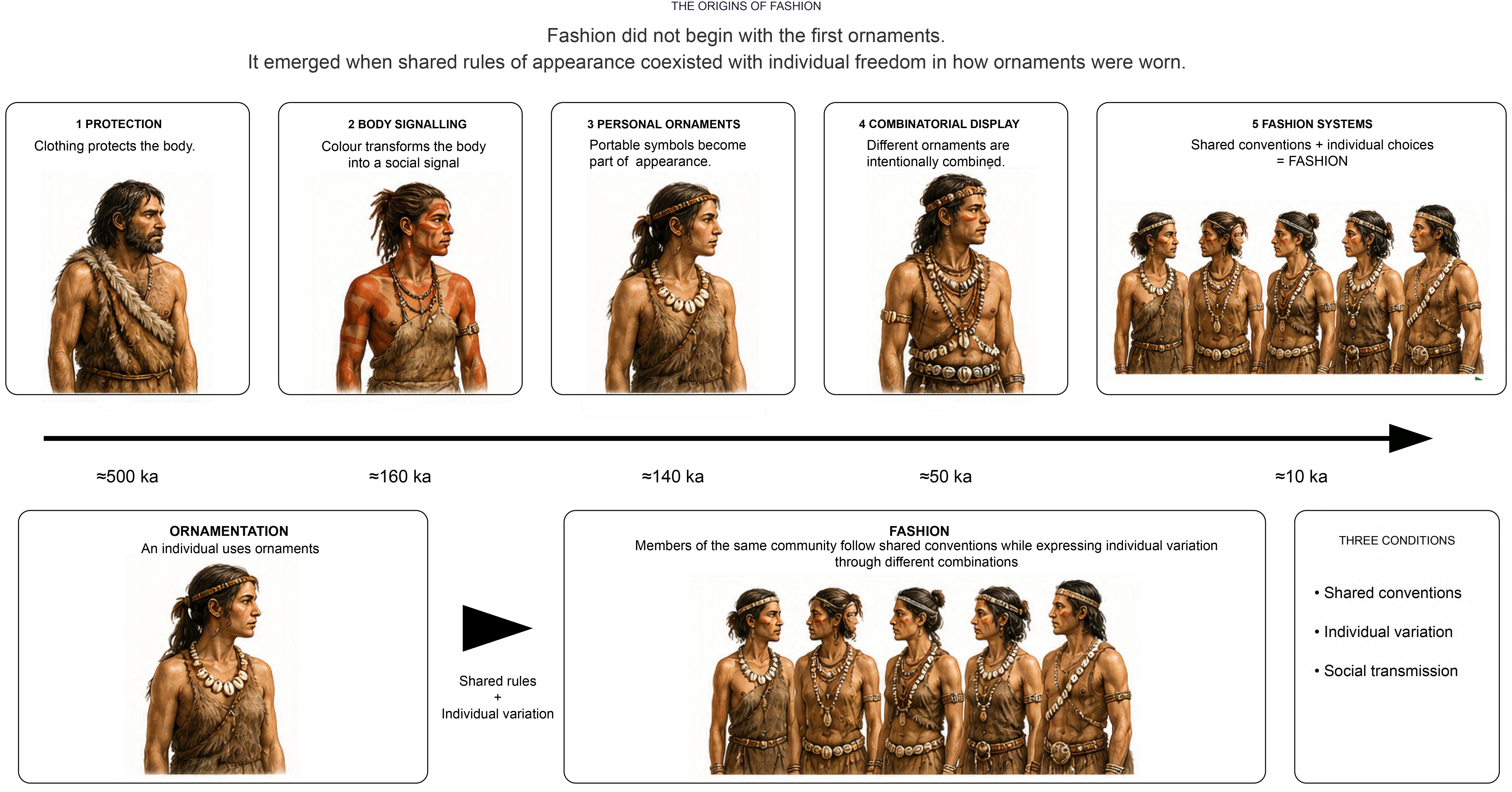
- Fashion does not emerge with the first garments or the first personal ornaments, but rather when collective conventions regarding the presentation of the body coexist with socially recognized individual variation.
- This new theoretical framework provides criteria for identifying the earliest fashion systems in the archaeological record and offers a fresh interpretation of the evolution of symbolic behaviors.
Early ornaments, pigments, and clothing attest to the long history of body modification practices. However, their presence alone is not sufficient to prove the existence of fashion. Until now, no definition has made it possible to distinguish simple ornamental traditions from true fashion systems in past societies.
In this study, Francesco d’Errico and Solange Rigaud propose a definition based on three archaeological criteria. Fashion is recognized when it combines shared conventions for presenting the body, recurring variation among individuals in the way they wear, pair, or combine adornments, and variation that cannot be explained solely by age, gender, status, or funerary practices. Fashion is thus defined as a system of visual communication in which individual differences are expressed within shared collective norms.
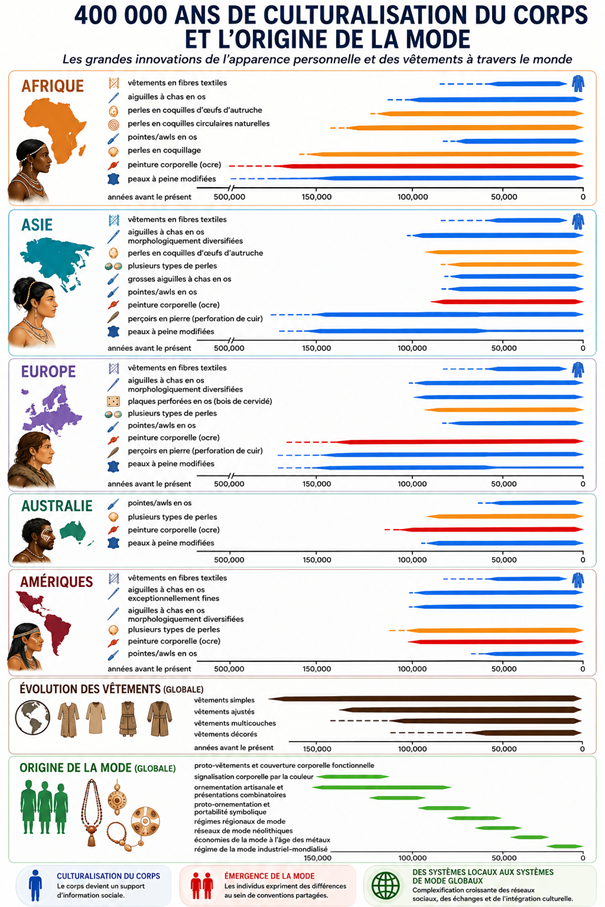
Applying this framework leads us to distinguish between two complementary evolutionary processes. The first corresponds to the “culturalization” of the body, which began with the first garments, the regular use of pigments, and the first adornments, all of which gradually transformed the body into a medium for social information. The second corresponds to the emergence of fashion proper, when these traditions became sufficiently structured to allow for individual differentiation without undermining the collective codes that make this differentiation intelligible.
According to the authors, currently available data suggest that the first fashion systems became truly discernible during the Upper Paleolithic, beginning around 45,000 years ago. Starting around 34,000 years ago, the earliest burials show individuals sharing common ornamental traditions while exhibiting differences in the selection, combination, or arrangement of ornaments. This dynamic becomes particularly evident in the Mesolithic (8,000 years ago) and the Neolithic (6,000 years ago) thanks to large burial complexes, which allow for the comparison of individuals belonging to the same community and the same period. These contexts reveal that appearance no longer merely reflects group membership or social status, but also forms of individual differentiation integrated into a collective system of bodily representation.
Beyond the question of the origins of fashion, this study provides a theoretical framework that can be applied to other archaeological contexts to examine the evolution of visual communication systems throughout human history. It also encourages us to view fashion as a component of cultural evolution, just like other technologies that enable the transmission, storage, and interpretation of social information.
Involved institutions
De la Préhistoire à l'Actuel : Culture, Environnement et Anthropologie (PACEA UMR 5199, CNRS - Université de Bordeaux, Ministère de la culture.
Figure captions
Fig. 1 The long-term emergence of fashion. Early clothing technologies initially evolved to protect the body, while ochre use and personal ornaments gradually transformed appearance into a medium of social communication. As ornament manufacture diversified and tailored clothing expanded the possibilities of bodily display, these different traditions converged into increasingly complex systems of appearance. Fashion emerged when members of the same community shared common conventions of dress and ornamentation while expressing individual differences through the way these elements were combined.
Fig. 2 When did fashion begin? The first ornaments were not yet fashion. Fashion emerged only when people belonging to the same community shared common rules of appearance but made different choices about how to wear and combine ornaments. In this way, bodily appearance became both recognizable and individually distinctive, giving rise to the earliest fashion systems.
Reference
F. d'Errico, and S. Rigaud, “The Origins of Fashion,” Evolutionary Anthropology: Issues, News, and Reviews35 (2026): e70039. https://doi.org/10.1002/evan.70039.
Researcher contacts
Francesco d’Errico
Directeur de Recherche CNRS
francesco.derrico@u-bordeaux.fr
PACEA UMR 5199, CNRS -
+33 5 40 00 26 28, +33 6 25 61 68 54
Solange Rigaud
Chargée de Recherche CNRS
PACEA UMR 5199, CNRS -
+33 6 51 95 48 44